Sustainability: what a full bus actually saves
A coach is not an electric car and not a bicycle. It is a diesel vehicle. Its advantage lies elsewhere: a fully occupied coach replaces around three dozen cars. Per person and kilometre, less is left over than with any other motorised means of transport apart from rail — and that is not a claim of ours, it is the German Environment Agency’s arithmetic.
What your trip costs — in CO₂
Pick a vehicle, enter the distance, set the number of passengers. The comparison uses the official figures from the German Environment Agency.
- Coach L, 57 people14 g/pkm · 240 kg in total25 l of diesel per 100 km
- Rail, long distance26 g/pkm · 445 kg in total47 % occupied
- Rail, regional44 g/pkm · 752 kg in total30 % occupied
- Car164 g/pkm · 2.8 t in total1.4 people per car
- Domestic flight290 g/pkm · 5 t in total73 % occupied
Over 300 km this group saves around 2,564 kg of CO₂ compared with driving their own cars — 91 per cent less.
Reference figures: German Environment Agency, TREMOD 6.71B (10/2025), data year 2024. Greenhouse gases as CO₂ equivalents per passenger kilometre, including extraction and refining of the fuel. Car, rail and air travel appear with their actual average occupancy — they are not calculated as if full. The figure for our bus is derived from diesel consumption rather than measured; at the official occupancy of 53 per cent this calculation matches the German Environment Agency figure for coaches to within about ten per cent.
Why the bus comes out so well
It is not the engine. It is the number of people inside.
A coach uses around 25 litres of diesel per 100 kilometres. That is roughly four times a mid-sized car — and it still comes out many times better per person. The reason is simple: the average car in Germany carries 1.4 people, while a chartered coach carries 50.
The German Environment Agency puts coaches at 30 grams of CO₂ equivalent per passenger kilometre, cars at 164 and domestic flights at 290. Only long-distance rail sits below, at 26 grams — and only because it runs on a growing share of renewable electricity.
With a charter coach there is a further point: it usually runs full. The official 30 grams apply to an average occupancy of 53 per cent. Put 50 people in a 50-seat coach and you land at roughly half of that.
Where the bus is not the answer
So it is clear what these figures do not mean.
A half-empty bus loses its advantage fast. With 15 people in a 50-seat coach, the figure per person is above that of a well-occupied car. That is why there is a slider for passengers in the calculator above — you see the effect immediately. And it is why we recommend the Sprinter or the minibus to smaller groups rather than the big coach, even though the big one would bring in more revenue.
On routes with a good rail connection, the train is the better choice. Berlin to Hamburg or Berlin to Munich is faster by rail and with fewer emissions. The bus plays to its strength where a group wants to travel door to door, where there is no direct connection, or where several stops are made along the way.
And we are not saying that travelling by bus is climate-neutral. There is no carbon offset in our price and no certificates we buy in order to claim it. What we have is a means of transport that uses very little per head — no more than that, but no less either.
What we do in day-to-day operations
Vehicles are allocated by group size, not by availability. A group of 18 gets the minibus, not a sixty-five-seater. It sounds obvious, but it is the biggest lever a bus company has at all — bigger than any drive technology.
We avoid empty runs wherever possible. If a bus takes a group to the Baltic coast and waits there instead of driving the route twice empty, that halves the emissions of the trip. On multi-day trips, having the driver stay overnight on site is therefore not only more convenient but also more economical.
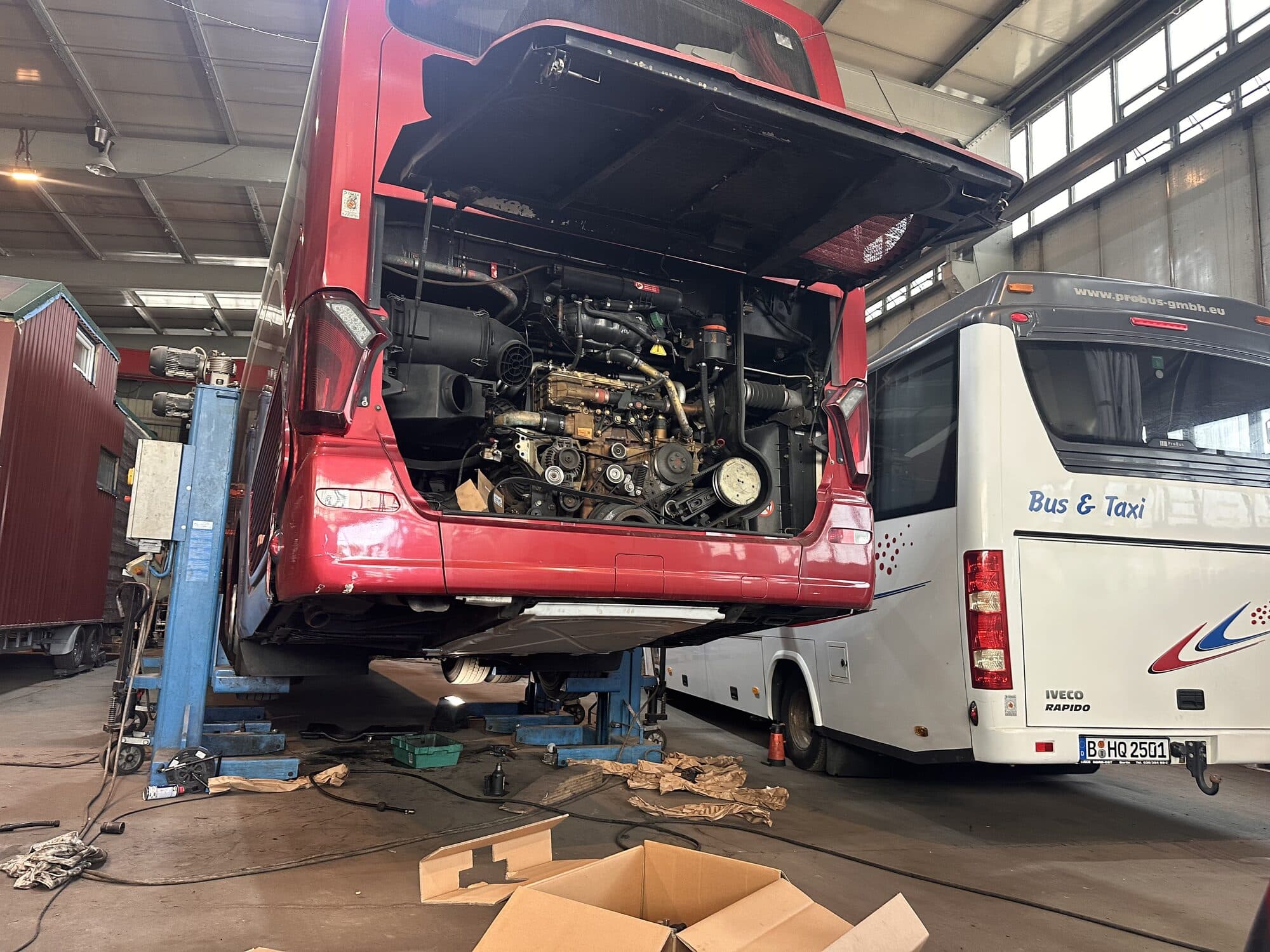
We maintain vehicles rather than disposing of them early. A coach is built for a long service life and covers many times the mileage of a car — the emissions from its manufacture are spread accordingly. Good maintenance is therefore not only a question of safety but of the balance sheet.
Servicing follows the manufacturer’s specifications, with quarterly inspections at Dekra. A badly maintained engine measurably uses more — maintenance is climate protection too, just without a sticker on it.
One bus instead of a whole car park
Emissions are one thing. The space a bus saves in a city is another.
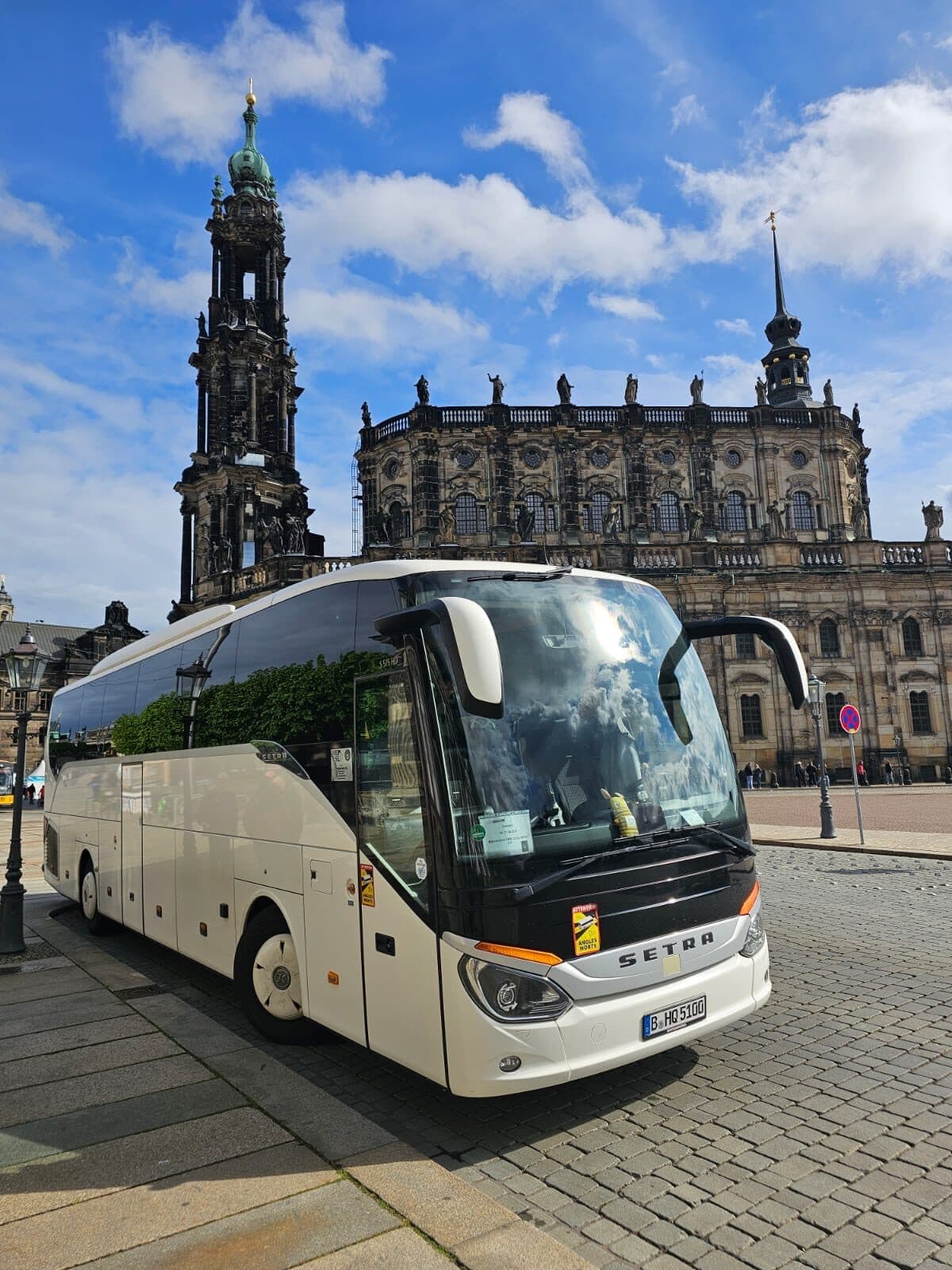
50 people in one coach — or in 36 cars cars. That number is not a guess: the average car in Germany carries 1.4 people.
Parked
8.6× as much1 bus53 m²36 cars450 m²A bus bay measures 3.50 × 15 m, a car space 2.50 × 5 m.
In traffic
15.6× as much1 bus15 m36 cars234 mVehicle length plus safe distance in slow-moving traffic.
Put another way: those 36 cars sit in traffic across 234 metres, nose to tail. For a group that fits into a single vehicle 15 metres long.
Pictures from the road
Common questions
Where do the comparison figures come from?
From the German Environment Agency, from the TREMOD model in version 6.71B of October 2025, data year 2024. They are greenhouse gases as CO₂ equivalents per passenger kilometre, including extraction and refining of the fuel. Car, rail and air travel appear there with their actual average occupancy — so they are not calculated in our favour.
And the figure for your bus?
That one is calculated from diesel consumption, not measured. The cross-check: at the official occupancy of 53 per cent, our calculation matches the German Environment Agency’s figure for coaches to within about ten per cent. We show the consumption we based it on inside the calculator, so the arithmetic stays traceable.
Do you offer carbon offsetting?
No. We think little of calling a journey “climate-neutral” for a few euros. If you need a figure for the trip for your sustainability report, we will work it out and disclose the assumptions. What we can substantiate, we substantiate — you will not get invented figures from us.
Do you have electric buses?
Not in coach travel. The range does not yet reliably cover day trips over 300 kilometres, and the charging infrastructure at excursion destinations simply does not exist. As soon as that changes, we will change too — until then we would rather say so than keep quiet about it.
What about manufacturing the vehicles?
That is not in the official figures — they look at operation. It still matters for the overall balance, and here the coach has a structural advantage: buses generally run for around 20 years and change hands several times in that period. The emissions from manufacture are therefore spread across many times the mileage a car covers in its lifetime.